

Can I afford a vacation home? Whether you’re eyeing a cottage, cabin, ski chalet or beach house, this vacation home calculator shows the most a lender might approve and a realistic price once running costs are included, for buyers in the US and Canada.
How Much Vacation Home Can I Afford?
How much vacation house you can afford depends on your income, your existing debts and what the home costs to run. Say you earn $100,000 a year, pay $1,800 a month on your main mortgage and have $50,000 to put down with a 7.7% mortgage rate. At a 45% debt limit, the calculator’s maximum purchase price is about $266,400, after property tax and insurance. Once it also sets aside 1% a year for upkeep, the realistic price is about $240,900.
A lender looks at whether you can carry the mortgage, property tax and insurance. Owning a cottage, cabin or ski chalet costs more than that: heating it through the winter, and upkeep you can’t put off. This calculator gives you two numbers: the top price at a 45% debt limit, and a realistic price once those costs are included.
Which calculator should I use? Buying a seasonal cottage, cabin or ski chalet? Use this one. Weighing any second property against your main mortgage? Use the Can I Afford a Second Home Calculator.
Number lower than you hoped? Our guide to how to afford a vacation home covers saving for the down payment, using home equity and rental income.
How to Use This Vacation Home Affordability Calculator
It works in two steps.
- In Step 1, enter your income and monthly debts. A positive result is what’s left each month for a vacation home. A result of zero or less means your debts have reached the 45% limit the calculator uses.
- In Step 2, enter your down payment, loan terms and running costs to see your maximum and realistic purchase prices.
Costs Unique to Vacation Homes
Mortgage rate and reserves. Wells Fargo says to expect a rate 0.25% to 0.50% above your first home’s mortgage. Chase says lenders often want proof of cash reserves covering several months of payments on both homes.
Maintenance. Fannie Mae suggests budgeting 1% to 4% of the home’s value a year: about 1% for a newer home, closer to 4% for one over 30 years old. A cabin exposed to snow, wind or salt air usually sits at the higher end.
Property tax. The average effective property tax rate on US single-family homes was 0.9% in 2025, according to ATTOM. It ranged from 0.33% in Hawaii to 1.84% in Illinois. In Canada, check the municipality’s property tax rate. Some resort towns charge more on homes that aren’t a primary residence. Canmore, Alberta, is one example.
Insurance when the home is empty. Standard home policies often limit coverage when a home sits empty. In New York, for example, the standard fire policy excludes losses after 60 consecutive days vacant or unoccupied. In Canada, many insurers can void your coverage if a home sits empty and unmonitored for more than four days, and coverage can lapse if it’s vacant for more than 30 days. Our insurance stated that our Whistler place couldn’t sit unoccupied for more than 30 days, so in slow rental periods our cleaner checked on it every couple of weeks. Your policy may differ, so check. Ask your insurer about a secondary-residence or seasonal policy, and read the vacancy clause.
Winterizing, heat and utilities. If the home is closed for the winter, you’ll need to shut off the water, drain the plumbing and protect the traps, or keep it heated and checked. Insurers may not pay for burst pipes in a home left empty, unchecked and unheated. At my Whistler properties, heating rose in winter, but snow clearing was covered by the strata fees. A detached cabin owner pays for it directly.
Vacancy taxes in Canada.
- BC’s Speculation and Vacancy Tax: applies in designated areas. For 2026 the rate is 1% for Canadian citizens and permanent residents, and 3% for foreign owners and people who don’t pay tax on worldwide income. The foreign-owner rate rises to 4% in 2027.
- Vancouver’s Empty Homes Tax: 3% of assessed value.
- Toronto’s Vacant Home Tax: 3% of assessed value for homes empty six months or more.
Many recreational areas aren’t covered by these taxes. Whistler, for example, isn’t a Speculation and Vacancy Tax area, but Squamish and Kelowna are. Always check before you buy.
What Lenders Look for on a Vacation Home
- Debt-to-income ratio. The calculator allows total debts of up to 45% of gross income. Fannie Mae allows up to 50% through its automated underwriting, but many lenders set a lower limit, often around 43–45%, and many prefer 36% or less. Canadian lenders use two tests on insured mortgages: housing costs up to 39% of income and total debts up to 44%, so Canadian buyers should treat the result as an upper limit.
- Down payment. The US minimum for a second home is 10% on a conventional loan. In Canada, a cottage you use yourself can qualify with 5% down on the first $500,000 and 10% on the rest, through CMHC, Sagen or Canada Guaranty. For that rate, the home must be winterized, with year-round access, and priced under $1.5 million. A seasonal cottage can’t get 5% down, but Sagen insures some with 10% down, using your own money. Many lenders still want 20%, especially for seasonal or water-access properties.
- Rate. We add about 0.375 percentage points for a second home, the middle of the range Wells Fargo gives above. That’s about 7.6% in the US, against a 7.24% average for primary homes, on October 29, 2026, and the calculator rounds up to 7.7% to be cautious. In Canada, 5-year fixed rates ran from about 4.6% at nesto to about 5.1% to 5.2% at RBC for buyers with 20% down, in early November 2026.
- Rental income. If the lender classes the place as a second home, rental income usually won’t help you qualify. If it’s mainly a rental, it’s an investment property: higher rate, at least 15% down in the US and 20% in Canada. In Canada, insured second-home programs exclude rental properties, so ask before you plan on any rentals. Our Investment Property Affordability Calculator handles that case.
- Home equity. A home equity loan or line of credit on your main home can fund the down payment. At federally regulated lenders in Canada, the revolving part of a HELOC is capped at 65% of your home’s value, and 80% including your mortgage. Credit unions may differ. The payment counts as a debt in Step 1.
- The property itself. Seasonal access, wells, septic systems and wood heat can limit which lenders will finance a cottage. Ask early.
Can I Afford a Vacation Home If I Still Have a Mortgage on My Main Home?
Often, yes. Lenders look at your total debts, including both mortgages, against your income. Step 1 of the calculator includes your current mortgage, so a positive result means you have room under the 45% limit it uses.
Illustrative Example
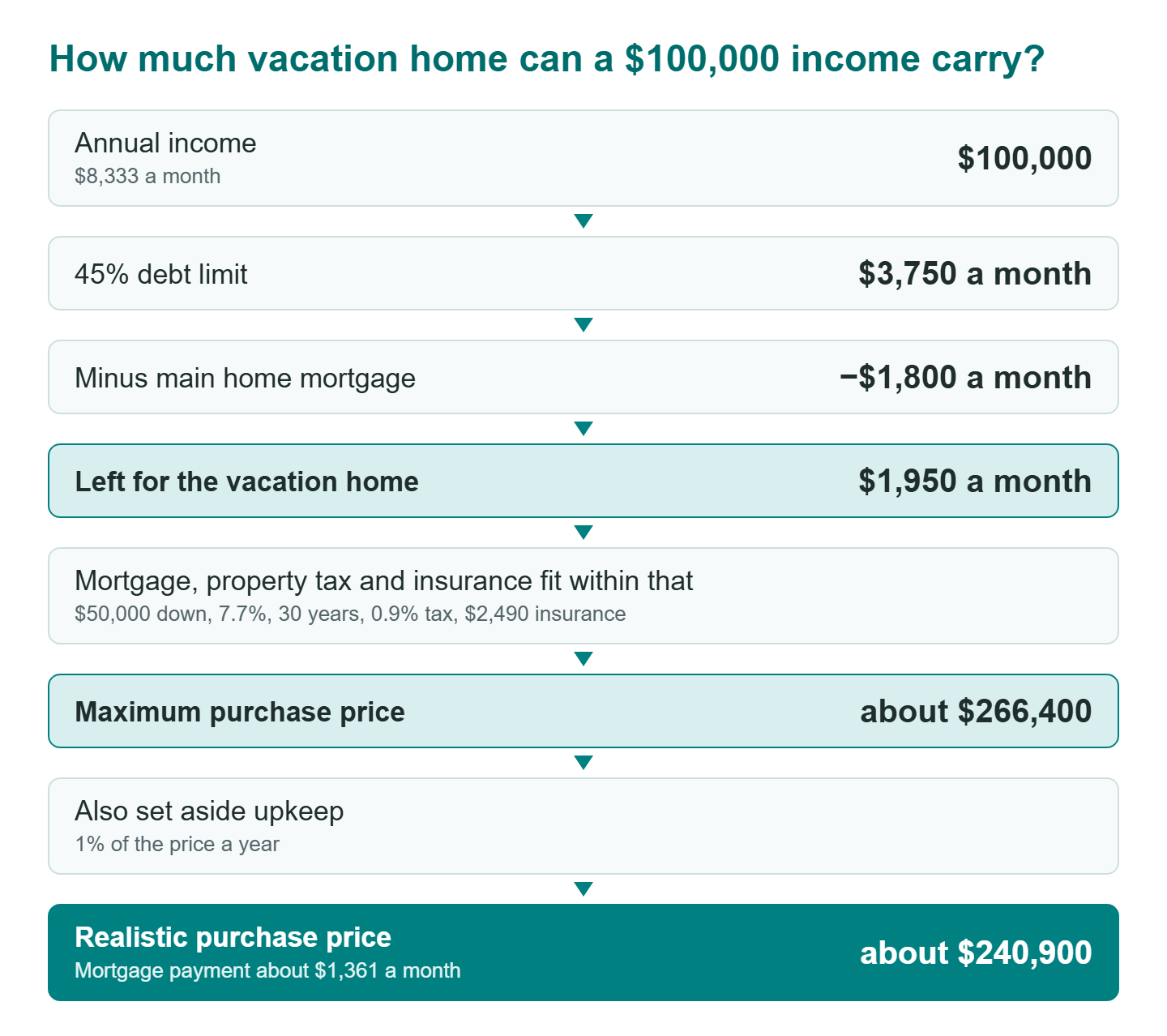
Say you earn $100,000 a year and already pay $1,800 a month on your main mortgage, with no other debts. At a 45% debt-to-income limit, you can spend $3,750 a month on all your debts. After your main mortgage, that leaves $1,950 a month for the vacation home. With $50,000 down at 7.7% over 30 years, and the calculator’s defaults of 0.9% property tax and $2,490 a year for insurance, the maximum purchase price is about $266,400. Add 1% a year for maintenance and the realistic purchase price is about $240,900, with a mortgage payment of about $1,361 a month.
Frequently Asked Questions
How do I know if I can afford a vacation home? Add up all your monthly debts, including both mortgages, and compare them with your gross income. Fannie Mae allows up to 50% through its automated underwriting, but many lenders set a lower limit, often around 43–45%. Chase, for example, says lenders usually prefer below 43%. In Canada, CMHC caps total debt service at 44% on insured loans. Then add the vacation home’s own costs (tax, insurance, heat and upkeep) and check that they fit your budget, not just the lender’s.
Do you have to put 20% down on a vacation home? Not in the US: Wells Fargo says conventional loans commonly require 10% on a second home, and Chase says most lenders expect 10% to 20%. In Canada, an insured second home can need as little as 5% on the first $500,000 and 10% on the rest, but Canada Guaranty requires it to be winterized, with year-round access, and priced under $1.5 million. A seasonal cottage needs more: at least 10% through Sagen’s vacation home program, and often 20% or more from the lender. RBC says default insurance applies above 80% of the home’s value, and in some cases above 65%, depending on the property. See our minimum down payment guide.
Can I afford a $500K vacation home on a $100K salary? Not with 10% down, even with no other debt. With 10% down at 7.7%, principal and interest is about $3,208 a month, plus about $375 in property tax. Add about $208 for insurance and the total is roughly $3,790 a month, over the $3,750 limit at 45% of income, before upkeep. With $50,000 down and no other debts, the calculator’s maximum is about $494,800 and its realistic price is about $447,500.
How much can I afford for a vacation home on $70,000? With no other debts, 45% of income allows about $2,625 a month. With 10% down at 7.7%, including 0.9% property tax and $2,490 of insurance, that’s a price of about $337,000, before upkeep. So a $300,000 home can work on those numbers, but any existing mortgage brings the limit down sharply.
Talk to a lender or mortgage broker before you make an offer.
Written and developed by Peter Davis. Peter owned and operated multiple vacation rental properties in Whistler for almost a decade. He writes about buying, financing and owning second homes in the US and Canada.