

Vacation home insurance is a policy for a home you don’t live in full time: a cabin, a cottage, a beach condo or a ski-town townhouse. You’ll also see it called second home, seasonal, cabin or cottage insurance. It works much like the policy on your main home, with one big difference: insurers price the months nobody is there. Most of the surprises owners run into sit in the policy wording, not the price.
I insured a rental condo and eventually a townhouse in Whistler for years. The policy that mattered wasn’t a standard condo policy. It was a specialty resort-property policy with its own rules on vacancy, renting and theft. This guide covers what I wish every owner knew before signing, for both the US and Canada.
Key takeaways
- Your main home policy usually won’t cover a second home’s building. Expect a separate policy.
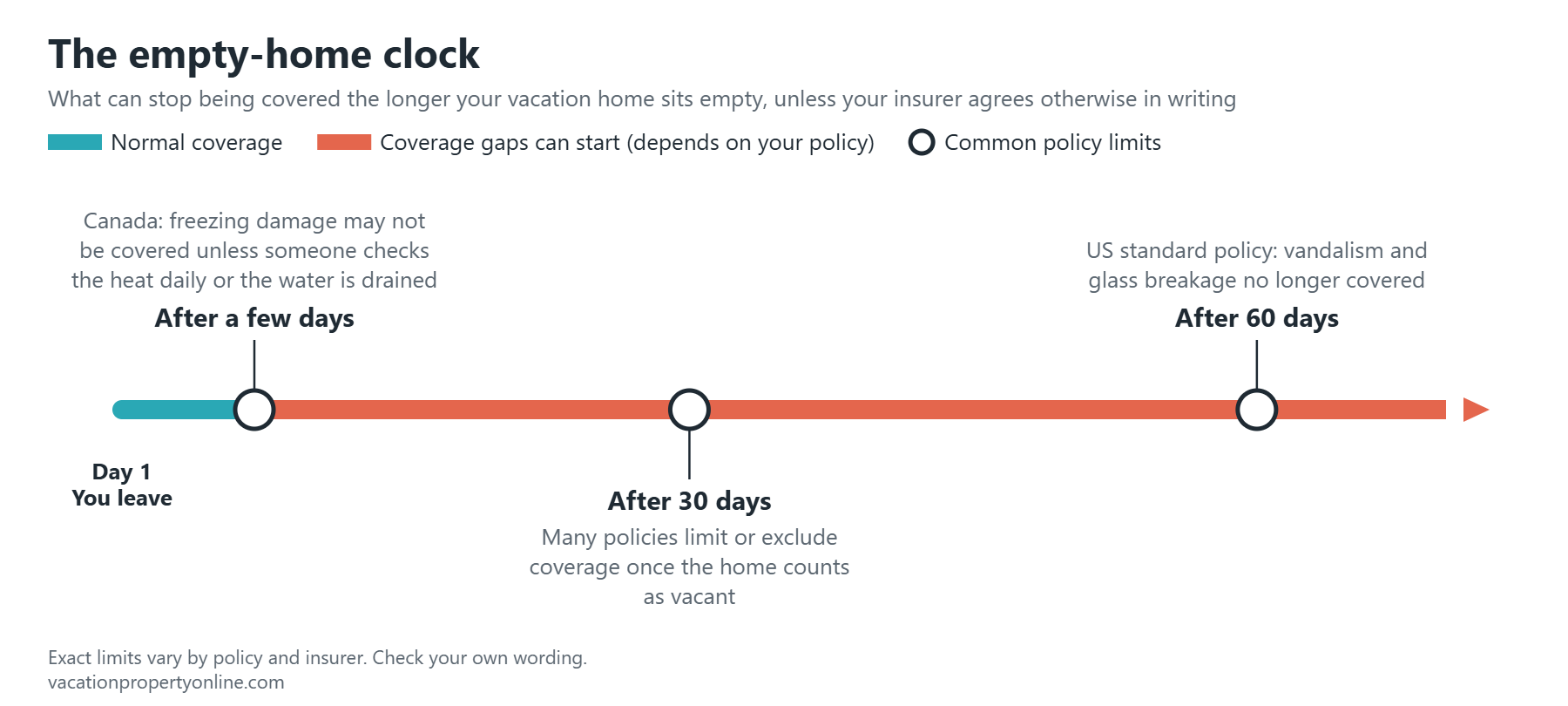
- Empty-home rules can start after a few days, 30 days or 60 days, depending on the policy and the peril.
- Renting it out, even for a few weeks a year, usually needs a different policy or a written endorsement.
- Flood isn’t in a standard base policy, in either country.
- Get the vacancy and rental terms in writing, and read the conditions, not just the limits.
In this guide
- Do you need a separate policy?
- The empty months: vacancy rules
- Renting it out
- Condo and strata units
- What it costs
- What isn’t covered
- Coast and wildfire country
- Insuring a cottage in Canada
- Cross-border owners
- Where to get coverage: 15 questions to ask
- FAQ
Do you need a separate policy for a vacation home?
Usually, yes. A homeowners policy is written for one “residence premises”. In the US, the standard HO-3 policy form extends its liability coverage to another home you own only if that home is listed on your declarations page (or bought during the policy period), and it doesn’t insure the second building at all. If there’s a mortgage, the lender will require the building to be insured anyway.
The policy types you’ll typically be offered:
| Policy | What it is | Good for |
|---|---|---|
| HO-3 written as a secondary or seasonal home (US) | A homeowners policy adapted for part-time use | A house you use yourself and rarely rent |
| Dwelling fire DP-1, DP-2, DP-3 (US) | Building-focused policies that the North Carolina Department of Insurance says are typically used for homes that aren’t your primary residence, usually without liability. DP-1 is basic named perils at actual cash value; DP-3 is open perils on the building | Rentals and homes empty for long stretches; add a separate liability policy |
| HO-6 or condo unit policy | Covers your unit, contents and liability; the association insures the building | Condos and townhouses in an association |
| Seasonal dwelling policy (Canada) | A basic, limited policy for a cottage used part of the year. Theft and vandalism usually aren’t covered by default | Cottages closed for the winter |
| Homeowner’s or specialty resort policy (Canada) | Fuller coverage for a cottage used most weekends or year-round, or a specialty policy for resort rentals | Four-season cottages and resort rental units |
In Canada, insurers often expect all-weather road access and regular use for the fuller policy, and some will only insure your cottage if they also insure your main home. Ask about that before you shop around.
The empty months: vacancy rules and how to stay covered
This is where most vacation home claims go wrong. Every policy has rules about how long a home can sit empty, and they’re stricter than most owners assume.
“Vacant” and “unoccupied” aren’t the same. A vacant home is empty of people and belongings. An unoccupied home is furnished, but nobody is there. Policies treat vacant and unoccupied homes differently, so check which word your policy uses.
US: the standard HO-3 wording.
- Vandalism and glass breakage aren’t covered if the home was vacant for more than 60 consecutive days before the loss.
- Frozen pipes are covered only if you used reasonable care to keep the heat on, or shut off the water and drained the system.
- Some insurers use 30 days instead of 60.
Canada: often stricter. In one Canadian insurer’s homeowner wording, losses aren’t covered once the home has been vacant for more than 30 consecutive days. Freezing damage often isn’t covered if the home was left for more than a few days in the heating season (4, 7 or 10 days in the wordings we checked), unless someone went in daily to check the heat, or the water was shut off and drained. The General Insurance OmbudService says most insurers treat a home as vacant after 30 days.
My Whistler policy worked the same way: under its terms, the unit couldn’t be unoccupied for more than 30 consecutive days. The standard mortgage clause on the same policy also singled out vacancy beyond 30 consecutive days as something the insurer had to be told about.
Most owners don’t check. In an October 2026 TD/Leger survey, 81% of secondary-property owners planned to leave their place unattended, while only 15% of all respondents would check what their policy requires, and only 7% would tell their insurer. 62% of seasonal owners who had left a property unattended reported a problem.
How to stay covered through the empty months:
- Tell your insurer which months the place usually sits empty.
- Ask how often someone must check it (daily, every few days or weekly), and get the answer in writing.
- Decide between draining the plumbing and keeping the heat on, and follow the policy’s exact condition.
- Ask about a vacancy permit or a seasonal policy if it will be empty longer than the policy allows.
- Install water-leak and temperature sensors that alert your phone. Some insurers give a small discount for a smart water device.
- Keep a simple log of visits and checks. It’s your evidence if you ever make a claim.
What changes if you rent it out
Renting your place out, even for a few weeks a year, changes how an insurer sees it. Homeowners policies exclude business activity. In the US, the 2011 standard forms count more than $2,000 of rental income in the past 12 months as a business, and newer 2022 forms treat “home-sharing host activities” as business with no dollar threshold at all. The Insurance Information Institute warned in March 2026 that owners who don’t tell their insurer about short-term rentals risk denied claims, lower liability limits, higher deductibles or cancellation, and that breaking local permit rules can also put coverage at risk.
In Canada, standard cottage policies commonly allow rentals of up to about 30 days a year. Some cottage policies sell extensions to 60, 90 or 180 rental days, with rental income cover.
| How you use it | Usual policy | What to tell the insurer |
|---|---|---|
| Family use only | Secondary home or seasonal policy | The months it sits empty |
| A few rental weeks a year | The same policy with a rental or home-sharing endorsement, if the insurer offers one for that home | Rental days per year, and how you book (platform or direct) |
| Regular short-term rentals | A short-term rental or resort rental policy, or a dwelling fire policy plus liability | Weeks rented, who manages it, licences and permits |
| Long-term tenant | A landlord (dwelling fire) policy; the tenant buys their own contents insurance | The lease term and that you don’t live there |
My experience: we told the insurer about the short term rental use upfront, because a rental needs a different policy. Ours was a specialty resort-property policy with the occupancy listed as rental, and it included a written endorsement expressly permitting short-term rental. That one line is what you want to see on your own policy. The application also asked how many weeks a year the unit was rented.
Read the conditions too. Ours covered theft only where there was a break-in, excluded theft by guests, had a lower limit and its own deductible for guest vandalism, and banned hot plates, a condition that would have voided the policy if broken. None of that shows up in the headline limits.
What Airbnb and Vrbo do and don’t cover.
- Airbnb: host damage protection of up to US$3 million, which Airbnb says isn’t insurance. It excludes wear and tear, acts of nature and mold, and has to be reported within 14 days of checkout. Host liability insurance is US$1 million.
- Vrbo: US$1 million liability on top of your own liability policy, only for stays booked and paid through Vrbo, and no cover for damage to your own property.
Neither replaces your own policy.
The mortgage catch (US). If you bought with a second-home mortgage, Fannie Mae’s occupancy rules say the home can’t be “primarily used or operated as a rental property” or managed by a firm that controls who stays there. Talk to your lender before you rent it regularly. See Changing a Second Home to an Investment Property.
Local rules. Renting without a required licence, permit or registration can also put your coverage at risk, so check your town’s short-term rental rules before you list. In BC, that includes the province’s short-term rental registry; see our BC Short-Term Rental Rules guide.
Condo and strata vacation units
In resort towns, many owners buy a unit, not a house. That splits the insurance in two: the strata corporation (or, in the US, the condo or homeowners association) insures the building, and you insure everything else.
In BC, the strata corporation must insure the buildings and common property at full replacement value and carry at least $2 million in liability; earthquake and flood aren’t mandatory. Strata deductibles of $25,000 to $100,000 are common, and some buildings now carry deductibles of $100,000 to $750,000 or more. If you’re responsible for a loss, for example because it started in your unit, the strata can charge its deductible back to you, and unless its bylaws say otherwise, under the Strata Property Act it doesn’t have to prove you were negligent. Earthquake deductibles on strata policies typically run 10–20% of the building’s replacement value, and your share of that can arrive as a special levy.
How my rental unit policy was built:
- No building coverage, because the strata insured the building.
- Contents.
- $2 million liability.
- Unit improvements, on an all-risk basis.
- Special levy (loss assessment) cover, for my share of a strata assessment.
- Loss of rental income (“fair rental value”), which pays if a covered loss stops you renting.
Why this matters, from experience: a leak from the unit above ours damaged our ceiling. Because the damage was to our unit, the claim went through our own insurer, not the neighbour’s or the strata’s. That fits with the deductible rule above. When a loss falls under the strata’s deductible, each owner often claims for the damage in their own unit on their own policy, regardless of who caused it. The strata, or your insurer, can then try to recover costs from the owner who was responsible. Nobody in our unit did anything wrong. Claims can come from people and pipes you don’t control, so your policy has to match how you actually use the place, rental use included.
In the US, the same split applies: the association’s master policy covers the building, and an HO-6 unit policy covers your interior, contents and liability, with loss assessment coverage for your share of the association’s deductible or a special assessment.
Before you buy a unit, ask for the strata’s or association’s insurance summary and deductibles, then match your unit policy to them.
How much does vacation home insurance cost?
Is second home insurance more expensive? Yes, in most cases. There’s no fixed markup: the price depends on how the home is used. The more months it sits empty, the more you rent it out and the more remote it is, the more you’ll pay. That’s why published estimates range so widely, from about 10% more to two or three times the cost of insuring a similar primary home. The figures below show what owners typically pay, and a quote for your own property is the only number that counts.
US context (primary homes). The average HO-3 homeowners premium was $1,569 in 2022, based on NAIC data. Freddie Mac put the average at $1,522 in 2023, up 40.8% since 2018. An August 2026 NAIC analysis found inflation-adjusted premiums rose 18% to 43% by region from 2018 to 2024. Expect a second home to start from figures like these and go up.
Canada. Brokers commonly quote $800 to $3,000 a year for most cottages. Prices are rising: in Haliburton, Ontario, one cabin’s premium went from just over $400 to $1,600, as reported in 2025, and the highest quote was $3,200.
My example: our Whistler rental townhouse unit cost about $1,200 to $1,400 a year to insure in 2023, with no building coverage needed because the strata insured the building. Water damage, flood and sewer backup each carried their own separate, higher deductible, and earthquake had a percentage-of-value deductible. Check every deductible, not just the main one.
What drives the price:
| Factor | Why it matters |
|---|---|
| Location | Coast, wildfire zone or flood plain |
| Fire protection | Distance to a hydrant and the responding fire hall, and whether the fire department is volunteer |
| Heating | Wood stoves cost more to insure; in Canada, wood stoves need a WETT inspection |
| Construction and age | Log homes, older roofs, plumbing and wiring |
| Access | Seasonal roads and water-access-only lots |
| Use | Months empty, rental weeks and claims history |
| Coverage basis | Replacement cost costs more than actual cash value, but pays much better |
Ways to lower it:
- Bundle with your main home: about 10% in Canada, per Ratehub.
- Add a smart water shut-off device (about 3%) or a monitored alarm (5–10%), per the same source.
- Raise your deductible, if you can absorb it.
- Update the roof, plumbing and electrical, and tell your insurer when you do.
To see insurance alongside your other carrying costs, try our Vacation Home Calculator.
What vacation home insurance usually doesn’t cover
Flood, in the US. Standard policies exclude it. You need a National Flood Insurance Program (NFIP) policy or private flood cover. According to FEMA, NFIP limits are $250,000 for the building and $100,000 for contents, there’s usually a 30-day wait before cover starts, and claims averaged $52,000 from 2019 to 2023. The NFIP needs regular renewal by Congress, so check it’s active before you buy. Second homes also pay a higher annual NFIP surcharge than primary homes: $250 versus $25.
Flood, in Canada. Overland flood (water from an overflowing lake or river, or heavy rain or snowmelt, flowing into the home at ground level) and sewer backup (water coming up through your drains) are separate optional add-ons, and coastal flooding and storm surge are generally excluded. The Insurance Bureau of Canada says 94% of homes can get overland flood cover, but about 850,000 can’t, and these two perils made up nearly a quarter of home claims in 2025. The promised national flood insurance program still hasn’t launched, and in April 2026 the federal minister wouldn’t commit to a date. Don’t count on government disaster aid either: federal disaster assistance rules don’t pay for losses you could have insured, and choosing not to buy available cover doesn’t make you eligible.
Earthquake. A separate add-on in both countries, usually with a percentage-of-value deductible. In BC, the IBC estimates only 50–65% of homeowners carry it.
Also commonly excluded or limited:
- Wear and tear, rot, mold and pests.
- Damage after you broke a vacancy or heating condition.
- Rental activity you didn’t disclose.
- Theft without a break-in, and theft by guests, on some rental policies.
- Anything a policy warranty forbids, like the hot plate ban on my own policy.
Coast and wildfire country: when insurance is hard to get
If your vacation home is on the coast or in wildfire country, getting a policy at all can be the hard part. NAIC found insurer-initiated non-renewal rates rose between 96% and 216% by region from 2018 to 2024, so start shopping well before your renewal date.
- Florida. Citizens Property Insurance, the state’s insurer of last resort, caps rate increases for primary homes, but non-primary homes aren’t covered by that cap and can rise up to 50% a year. Citizens also requires flood insurance on homes with a dwelling value of $400,000 or more, and on all its policies from January 1, 2027.
- California. The FAIR Plan’s basic policy covers fire, lightning, internal explosion and smoke, with optional wind, hail and vandalism cover, up to $3 million, so owners pair it with a “difference in conditions” policy for everything else.
- Hurricane deductibles. In 19 states plus DC, hurricane deductibles are usually 1% to 5% of the home’s insured value, not a flat dollar amount, and the NAIC notes they can run as high as 15%.
Illustrative Example: a 2% hurricane deductible on a home insured for $300,000 means the first $6,000 of damage is yours.
- Canada. Insured severe-weather losses topped $2.4 billion in 2025, and inflation-adjusted losses were about $37 billion from 2016 to 2025, versus about $14 billion the decade before. Expect closer questions about wildfire and flood risk, especially for cottages close to the water.
Insuring a cottage in Canada: what insurers check
Cottage insurance is priced on details a city home never raises. Have answers to these ready before you call a broker. My own application asked about most of them.
- Fire protection: how far you are from a hydrant and the responding fire hall, and whether the fire department is volunteer.
- Heating: wood stoves need a WETT inspection. If a stove is your main heat source, expect a higher premium, and some insurers decline.
- Access: an all-weather road versus a seasonal road. Island and water-access-only cottages are harder and costlier to insure.
- Docks, boathouses and bunkies: these may be covered differently from the cottage itself on some cottage policies, so ask how each is covered.
- Outbuildings: often covered at a set percentage of the main building’s limit. One Saskatchewan seasonal package covers them at 15%.
- Boats: some cottage packages include liability for small boats (that same package covers up to 50 horsepower). Larger boats need their own policy.
- Systems: alarms, the plumbing type, the age of the roof, wiring and plumbing, and whether you have a septic system and well.
- Use: the weeks you’ll be there, the weeks you’ll rent it, and the months it sits empty.
For more on waterfront risks, see Owning Lakefront Property: Pros and Cons.
Cross-border owners
Americans with a Canadian cottage. Insure through a broker licensed in the province where the cottage is. Many brokers are licensed only in their own province, and remote or island cottages cost more to insure. Thinking of buying? Start with Can Americans Buy Property in Canada?
Canadians with a place in Florida or Arizona. You need a US insurer licensed in that state. An Ontario broker can’t place Florida coverage without a Florida licence and should refer you to a licensed Florida agency. Insurers will also expect a plan for checking the home while you’re back in Canada. See the Florida notes above.
Where to get coverage, and 15 questions to ask
There are four routes. Which one fits depends on how you use the place.
- Your current home insurer. The bundling discount is useful, and you deal with one company, but many insurers don’t write seasonal or rental homes.
- An independent broker. Usually the best route for cottages, condo units with big strata deductibles, rentals and cross-border properties. They can reach specialty insurers that don’t sell direct. That’s how we found our resort rental policy.
- A specialty short-term rental insurer, if you rent regularly.
- The insurer of last resort (e.g. Citizens in Florida, the FAIR Plan in California), only when private cover isn’t available.
15 questions to ask your insurer or broker before your place sits empty:
- How long can the home be unoccupied, and how long vacant, before coverage changes?
- How often must someone check it in winter, and does that need to be in writing?
- Is freezing covered if I drain the plumbing instead of keeping the heat on?
- Do I need a vacancy permit or a seasonal policy for the months it’s empty?
- How many rental days a year does this policy allow?
- Does the policy expressly permit short-term rental, and can I see that wording?
- Is theft covered without a break-in, and is theft by guests covered?
- Is loss of rental income covered after a claim?
- Which perils have their own deductible: water, sewer backup, flood, earthquake?
- Is overland flood (Canada) or flood (US) available, and what does it cost?
- For a condo or strata unit: what does the building policy cover, and what is its deductible?
- Am I covered for a special levy or loss assessment, and up to how much?
- Are docks, boathouses, outbuildings and boats covered, and at what limits?
- Are there any warranties or conditions that could void the policy (wood stoves, hot plates, alarms)?
- Is coverage replacement cost or actual cash value?
FAQ
What does second home insurance cover? The building (unless a condo association or strata insures it), your contents and your liability, against the perils the policy names or doesn’t exclude. Vacancy limits, rental restrictions and separate deductibles shape what it actually pays, so read those sections first.
Is second home insurance more expensive? Yes, in most cases, because the home sits empty and may be rented. How much more depends on how you use it. See what drives the price.
Does my homeowners insurance cover my cabin or cottage? Usually not the building. Your main policy may extend liability to it if it’s listed on your declarations page, and may cover belongings kept there up to a small limit (10% of your contents limit on the standard HO-3). Get a separate policy.
Is vacation rental insurance worth it? If you rent more than a few weeks a year, yes. A standard policy can deny a rental-related claim or be cancelled, and Airbnb’s damage protection isn’t insurance.
Do I need flood insurance for a lake house or cottage? If you’re near water, it’s worth pricing. Flood is excluded from standard policies in both countries: in the US it’s a separate NFIP or private policy, and in Canada it’s an overland flood add-on, where available.
What happens if I don’t tell my insurer I rent it out? You risk a denied claim, reduced coverage or cancellation, even for a loss that had nothing to do with the guests.
Can I insure a vacation home owned through an LLC or family trust? Yes, but the owner on the policy should match the owner on title, and some insurers will want a dwelling or commercial policy instead of a homeowners policy. Tell your broker how the home is owned before you buy.
How do I insure a hunting cabin or a cabin on leased land? Many insurers treat a remote cabin as a seasonal dwelling, with basic named-perils coverage. On leased land you insure the building, your contents and your liability, not the land, so check the lease for any insurance it requires.
This guide is general information, not insurance or legal advice. Policy wordings vary, so confirm the details with a licensed broker or insurer where your property is.
Written by Peter Davis, who has owned and insured vacation rental property in Whistler, BC. Read our editorial standards.
