
Short answer: Yes. US citizens can buy property in Canada, but not everywhere right now. A federal ban stops most non-Canadians from buying homes in Canada’s census metropolitan areas and census agglomerations. It’s set to end on January 1, 2027, but the federal budget released on November 5, 2026 proposes extending it to January 1, 2029 for existing homes, while letting non-Canadians buy newly built homes. Many cottage and ski areas sit outside the ban’s boundaries, though some popular ones don’t. Vacant land isn’t covered. Several provinces add a foreign-buyer tax of 10–25%, and renting or selling later brings tax rules for non-residents.
This guide is general information only, not legal, tax or financial advice. Get advice from a Canadian real estate lawyer and a cross-border tax advisor before you buy.
Can a US citizen buy a house in Canada?
Yes, if the property is outside the ban’s areas or you qualify for an exemption.
What the foreign buyer ban covers, and its exemptions
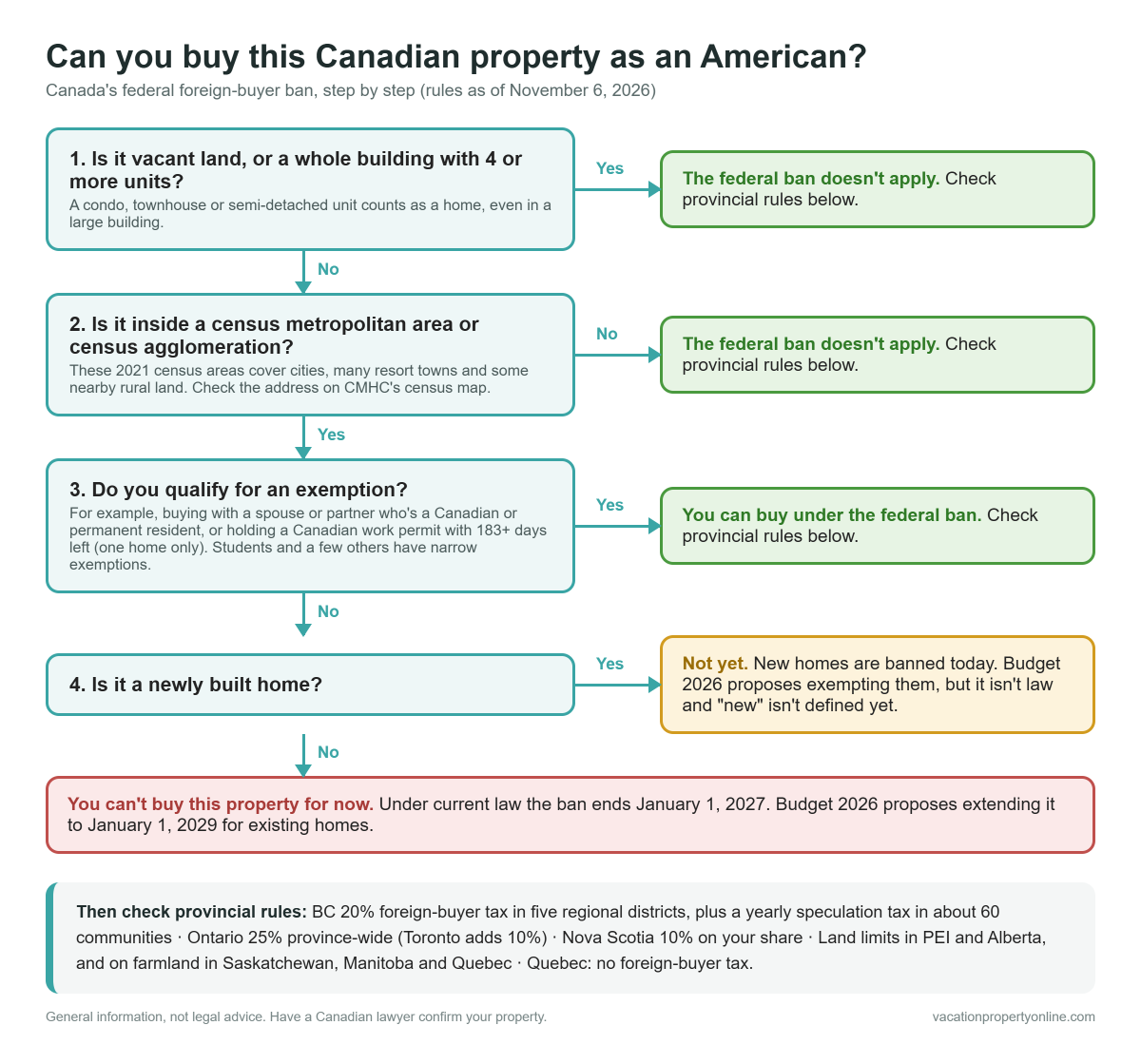
The federal law and its regulations work like this:
- Covers: non-Canadians buying residential property with 1–3 units (houses, semis and condos) inside census metropolitan areas or census agglomerations. Any company formed outside Canada, such as a US LLC or corporation, counts as a non-Canadian. So does a Canadian private company if non-Canadians hold 10% or more of its value or votes.
- Doesn’t cover: property outside those areas, a whole building with 4 or more units, or vacant land. A condo unit is still covered, even in a large building. There’s no separate “recreational property” exemption, so a cottage is exempt only if it’s outside those areas.
- Exemptions: work-permit holders with at least 183 days of authorization left (one property), and buyers purchasing with a Canadian or permanent-resident spouse or common-law partner.
- Penalty: a fine of up to $10,000, which can also apply to anyone who knowingly helps. After a conviction, a court can order the home sold, and you’d get back no more than you paid.
Which cottage and ski towns does the ban cover?
Whether the ban applies depends on the exact address. Here’s how popular cottage and ski towns compare, based on Statistics Canada’s 2021 list of census agglomerations, plus the Kelowna and Nanaimo metro areas:
| Named as a covered area | Not named on the list |
|---|---|
| Canmore, AB | Whistler, BC |
| Kelowna, Penticton and Vernon, BC | Banff, AB |
| Squamish, BC | Huntsville, Bracebridge and Gravenhurst (Muskoka), ON |
| Nanaimo, Parksville and Courtenay, BC | Mont-Tremblant, QC |
| Collingwood, Wasaga Beach, Midland and Kawartha Lakes, ON | |
| Sainte-Agathe-des-Monts, QC |
Treat this as a starting point. These areas can take in neighbouring municipalities, so have a Canadian lawyer or notary confirm the exact address on Statistics Canada’s boundary map before you make an offer.
Banff is a special case. All land in the town is leased from the federal government, and only “eligible residents” (mainly people who work or run a business in the park, plus some retirees and their families) can hold a residential lease or live there. So most buyers can’t own a home there at all.
Is Canada’s foreign buyer ban being extended?
Under current law, the ban ends on January 1, 2027. It has already been extended once, from January 1, 2025. On November 5, 2026, the federal budget proposed two changes:
- Extend the ban on existing homes, including resales, to January 1, 2029.
- Exempt newly built residential properties. This follows Australia, which bans foreign buyers from existing homes but not new ones.
Neither change is law yet. The government still has to introduce legislation and regulations. As of November 6, 2026, it hadn’t said exactly what counts as a new home or when the exemption would start. Until then, the current rules apply. Provincial taxes don’t change either way.
Could the new-home exemption help cottage buyers?
Possibly. If it becomes law, a newly built condo, townhouse or chalet in a covered area such as Canmore, Kelowna or Collingwood may be open to American buyers, while resale homes there stay off-limits until 2029. Whether pre-construction purchases and assignments qualify is still unclear. Provincial foreign-buyer taxes would still apply.
Can Americans buy land in Canada?
Yes. Vacant land isn’t covered by the federal ban, so it’s the simplest way to buy in a covered area, although provincial taxes can still apply. Some provinces limit land purchases:
- Prince Edward Island: non-residents, including Canadians from other provinces, need approval to hold more than 5 acres or 165 feet of shore frontage.
- Alberta: foreign buyers are limited to 20 acres outside cities and towns.
- Saskatchewan: non-residents are limited to 10 acres of farm land.
- Manitoba: non-Canadians are limited to 40 acres of farm land.
- Quebec: a non-resident needs approval before buying farm land.
- Nova Scotia: the 10% non-resident tax applies to residential vacant land.
Provincial foreign-buyer taxes
| Province | Tax on foreign buyers | Where |
|---|---|---|
| British Columbia | 20% additional property transfer tax, on fair market value | Metro Vancouver, Capital (Victoria), Fraser Valley, Central Okanagan (Kelowna) and Nanaimo regional districts. Not Whistler |
| British Columbia | Speculation and vacancy tax: 3% a year for foreign owners in 2026, rising to 4% from the 2027 tax year | About 60 communities, including Kelowna, Penticton, Vernon, Courtenay, Parksville, Victoria, Nanaimo and Squamish. Not Whistler |
| Ontario | 25% non-resident speculation tax on homes with 1–6 units. If any buyer on title is foreign, it applies to the full price. Buyers purchasing with a Canadian or permanent-resident spouse are exempt | Province-wide, including Muskoka and other cottage country |
| Ontario (Toronto) | 10% municipal non-resident speculation tax, on top of Ontario’s 25% | City of Toronto |
| Nova Scotia | 10% non-resident deed transfer tax on your share of the higher of the price or assessed value. It also applies to Canadians from other provinces and to residential vacant land | Province-wide. You don’t pay it if you declare at closing that you’re moving to Nova Scotia and prove residency within 12 months |
| Quebec | No foreign-buyer tax; standard welcome tax applies | — |
Illustrative Example: A US buyer paying C$800,000 for a Muskoka cottage owes C$200,000 in Ontario’s non-resident tax (C$800,000 × 25%), on top of about C$12,475 in regular Ontario land transfer tax (C$275 + C$1,950 + C$2,250 + C$8,000, from Ontario’s rates of 0.5%, 1%, 1.5% and 2%). That’s about C$212,475 in tax, or roughly 27% of the price. The same buyer pays neither the BC 20% tax nor the speculation tax on a Whistler condo, and no foreign-buyer tax on a Mont-Tremblant chalet. Compare other markets on our Canadian vacation property prices page, and see the running costs in Vacation Home Costs.
The federal Underused Housing Tax was eliminated for 2025 and later years by the Budget 2025 Implementation Act, No. 1 (law since March 26, 2026). If you owned Canadian housing in 2022–2024, returns, penalties and interest can still apply for those years.
Can Americans get a mortgage in Canada?
Yes, but you’ll need a much larger down payment than in the US. Expect to put down 35% or more at a major bank, and some ask for more. Requirements vary, so get quotes from several lenders. Canada’s government-backed mortgage insurance (CMHC) is only for Canadian citizens and permanent residents. You’ll also need a US credit report and proof of income. Compare a Canadian mortgage with paying cash or using a US home equity loan, as covered in how to finance a vacation home. Our can I afford a vacation home calculator can help you test the numbers.
How to buy property in Canada as a US citizen
- Check the ban. Use the flowchart above, and have a Canadian lawyer confirm the address.
- Budget for taxes. Add the provincial foreign-buyer tax, if any, to regular land transfer tax and closing costs.
- Line up the money. Get mortgage quotes (plan on 35% or more down), or arrange to move cash and compare exchange rates.
- Hire local help. You’ll need a real estate agent and a real estate lawyer (a notary in Quebec) in the province where you’re buying.
- Make an offer and close. Your lawyer or notary registers the title and pays the land transfer taxes from your funds.
- Set up for renting, if you’ll rent it. Appoint a Canadian agent and set up the non-resident tax filings before the first guest arrives (see “Renting out your Canadian property” below).
For the wider process, see our guide on how to buy a vacation home.
Renting out your Canadian property
- Default withholding: 25% of gross rent is withheld and sent to the CRA by your Canadian agent. With no agent, that duty can fall on whoever pays you the rent.
- A possibly better option: you may be able to elect under section 216 and file a Canadian return, paying tax on net rent instead. With an approved NR6 form, withholding may drop to 25% of net rent. Talk to a Canadian tax professional about whether this fits your situation.
- Short-term rental rules: local rules still apply. BC limits short-term rentals to the host’s own home in towns of 10,000+ people and some nearby communities. Resort areas like Whistler are exempt from that provincial rule, but Whistler allows nightly rentals only in properties zoned for tourist accommodation, with a business licence. Kelowna is exempt too, but the city allows short-term rentals of a home you don’t live in only at listed sub-zone addresses. See our BC short-term rental rules.
- Rule-breaking rentals lose deductions: this matters if you file a Canadian return to be taxed on net rent (the option above). Under a federal rule in effect since 2024, if a short-term rental (under 90 days) breaks provincial or local rules, you can’t deduct any of its expenses.
- GST/HST: stays under a month at more than $20 a night are taxable if you’re registered. Booking platforms collect the tax on stays booked through them for hosts who aren’t registered.
Selling your Canadian property
- Clearance certificate: notify the CRA on Form T2062 within 10 days of the sale. Without a certificate, the buyer can hold back 25% of the price, or 50% on certain property, which can include the building portion of a property you’ve rented out.
- Canadian tax: half of the capital gain is taxable. You file a Canadian return for the year of sale.
- US tax: as a US citizen you report the gain to the IRS too, and you can generally claim a foreign tax credit for the Canadian tax.
- Reporting: a Canadian home you own directly isn’t reportable on the FBAR or Form 8938, but Canadian bank accounts above the thresholds are.
Using the property
US citizens don’t need a visa to visit, but you need a passport or other accepted travel document. Border officers usually allow stays of up to six months per entry. Owning property doesn’t give you residency or immigration status, and spending 183+ days a year in Canada can raise tax-residency questions.
Checklist before you buy
Buying property in Canada as an American comes down to five checks:
- Is the address outside a census metropolitan area or agglomeration?
- If it’s a new build in a covered area, has the proposed new-home exemption become law, and does your purchase qualify?
- Which provincial foreign-buyer taxes apply?
- Can you rent it short-term under local rules?
- Have you lined up a Canadian lawyer or notary, a cross-border tax advisor, and a resident agent if you’ll rent it?
FAQ
Can a US citizen buy a cottage in Canada?
Yes, if the cottage is outside the ban’s areas or you qualify for an exemption. Muskoka’s main towns aren’t named on the list, but Ontario’s 25% tax applies there.
Can Americans own property in Canada?
Yes. The ban only limits buying. Once you own a Canadian property, you can keep it, rent it out under local rules and sell it.
Can foreigners buy property in Canada?
The same rules apply to all non-Canadians, not just Americans: the federal ban, plus provincial foreign-buyer taxes.
Is it hard for a US citizen to buy property in Canada?
The purchase itself is much like buying in the US. The hard parts are confirming the ban doesn’t apply, budgeting for provincial tax, and arranging a larger down payment.
Does owning property in Canada give me residency?
No. Property ownership gives you no right to live in Canada. You’d need to qualify through immigration separately.
How much down payment do Americans need?
Plan on 35% or more at a major bank, and compare lenders. Canada’s government-backed mortgage insurance is only for Canadian citizens and permanent residents.
Will the foreign buyer ban be extended?
It’s been proposed. The federal budget released on November 5, 2026 would extend the ban on existing homes to January 1, 2029 and exempt new homes. Until that becomes law, the ban is scheduled to end on January 1, 2027, so check the current rules before you make an offer.
This guide is for general information only and isn’t legal, tax or financial advice. Rules for non-residents change often and depend on your situation. Before you buy, get advice from a Canadian real estate lawyer (a notary in Quebec) and a tax advisor who handles both Canadian and US tax.
Written and developed by Peter Davis. Peter owned and operated multiple vacation rental properties in Whistler for almost a decade. He writes about buying, financing and owning second homes in the US and Canada. Read our editorial standards.
