

To afford a second home, you need four things: room in your budget for a second mortgage payment, a down payment of at least 10% in the US (as little as 5% in Canada), cash left over after closing, and money for the running costs of two homes. Lenders check the first three. The fourth is up to you.
If you’re asking “how can I afford a second home?”, start with what a lender will approve, then check whether you could still carry both homes in a tough year, such as a big repair, a drop in income or a slow rental season. This guide covers first what lenders check and then how to test your own budget. To see what price you could qualify for, enter your income and debts in our Can I Afford a Second Home Calculator.
Start With the Lender’s Math: Two Mortgages, One Income
Lenders decide how much you can borrow mainly by your debt-to-income ratio. That’s your monthly debt payments divided by your gross monthly income. For a second home, the payments on both homes count.
- US: Fannie Mae allows up to 50% through its automated underwriting, but many lenders set a lower limit, often around 43–45%. Fannie Mae is a government-sponsored company that buys standard mortgages, so many lenders follow its rules.
- Canada: CMHC uses 39% of income for housing costs and 44% for total debts. Federally regulated lenders also test you at the higher of your rate plus 2% or 5.25%.
Illustrative Example: how much second home a $168,000 income supports
This US couple earns $14,000 a month before tax. They pay $2,600 a month for their main home, including taxes and insurance, and $400 for a car loan.
| Step | Amount |
|---|---|
| Most total debt at a 45% limit (45% of $14,000) | $6,300 a month |
| Minus existing debts ($2,600 + $400) | −$3,000 |
| Room for the second home’s payment | $3,300 |
| Minus the second home’s taxes, insurance and fees (estimate) | −$650 |
| Left for the mortgage itself | $2,650 |
| Mortgage that payment supports (30 years at 7.7%) | About $372,000 |
| Price with 20% down (down payment about $93,000) | About $465,000 |
The 7.7% rate is Freddie Mac’s 30-year average of 7.24% on October 29, 2026, plus an assumed second home premium of about half a point, the default in our calculators. Second home rates can run 0.25 to 0.5 points above a main home’s, though there’s no fixed rule, so compare quotes. With 10% down, the same payment buys less: about $413,000 before private mortgage insurance, and the insurance premium lowers that further.
Work Out Your Own Number
The example above uses one couple’s figures. To see what you could afford, enter your own income, debts and down payment in our Can I Afford a Second Home Calculator. It counts your existing debts alongside the new mortgage and estimates the most you could spend on a second home.
If the number is lower than you hoped, the rest of this guide covers ways to change it: a bigger down payment, paying down other debts, home equity, or buying with someone else.
Save the Down Payment
The minimum down payment for a second home is 10% on a conventional US loan. In Canada it can be 5% of the first C$500,000 and 10% of the rest, with mortgage insurance, on homes under C$1.5 million. A seasonal cottage or a property you’ll rent out needs more. Our guide to the minimum down payment for a second home has the full rules.
Putting 20% down avoids mortgage insurance in both countries and lowers your monthly payment. That leaves more room in the debt-to-income test.
Keep Cash in Reserve After Closing
Lenders want to see savings left over once you’ve paid the down payment and closing costs. For a second home, Chase says well-qualified borrowers likely need at least two months of payments in reserve, and less-qualified borrowers at least six months. Retirement and investment accounts can often count.
Your own cushion should be bigger. A second home brings repairs you didn’t plan for, often when you’re not there to catch them early.
Budget for the Full Cost of Two Homes
The mortgage is only part of it. A second home has its own property taxes, insurance, utilities, maintenance and, for condos, HOA or strata fees. A common rule of thumb is 1% to 4% of the home’s value a year for upkeep, more for older homes. Travel to and from the place adds up too.
Our breakdown of vacation home costs lists what to expect. Before you buy, write down a full year of costs and check you could carry them with no rental income at all.
From experience: At our Whistler places, April and May and October to late November were slow. For four to five months a year, the rent didn’t cover the costs, and we carried both homes ourselves. Plan on doing the same before you count on rental income.
Can I Afford a Second Home to Rent?
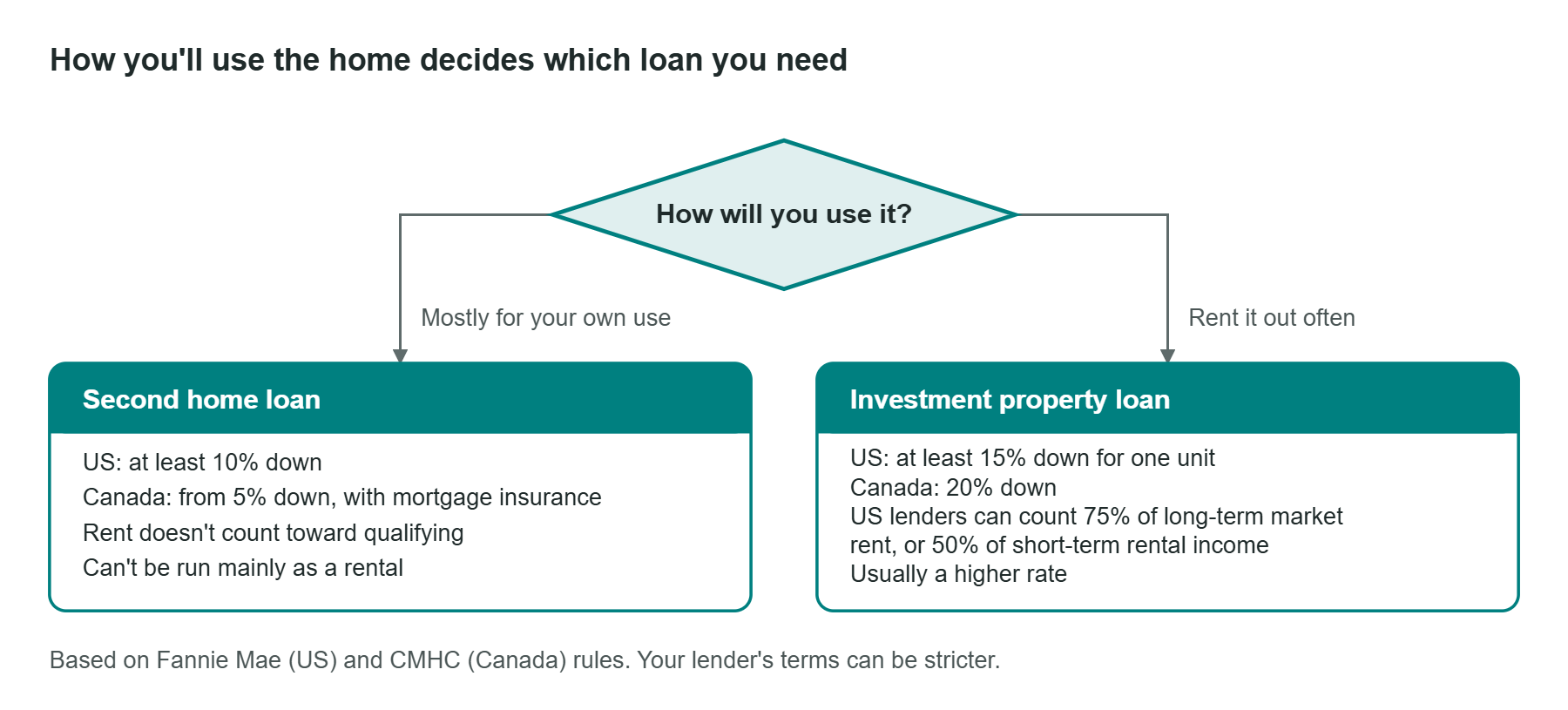
Renting the place out can cover part of the cost, but it changes the loan, and it doesn’t help you qualify for a second home mortgage. That’s the second home vs investment property question: lenders decide which loan you need by how you’ll use the place.
- Second home loan: Fannie Mae doesn’t let rental income from a second home count toward qualifying. You must use the home yourself for part of the year. It can’t be run mainly as a rental or be under an agreement that gives a management company control over who stays there.
- Investment property loan: if you’ll mainly rent it out, you need an investment loan. Fannie Mae then lets lenders count 75% of the appraiser’s long-term market rent, or 50% of documented short-term rental income, but you’ll need at least 15% down for one unit in the US and 20% in Canada, and the rate is usually higher.
- Canada: CMHC’s second home insurance is for homes you’ll occupy yourself, with year-round access; rentals don’t qualify, so the 5% down option isn’t available on a home you plan to rent.
Taxes: in the US, if you rent the home for 14 days or fewer in a year, you don’t have to report the rent. Rent it longer and it stays your residence for tax purposes only if your personal use is more than 14 days or 10% of the days it’s rented, whichever is greater.
To test a rental plan, try our Investment Property Mortgage Calculator.
Ways to Fund a Second Home
- Home equity: a home equity line of credit (HELOC), home equity loan or cash-out refinance on your main home can cover the down payment. A cash-out refinance to buy a second home replaces your current mortgage with a larger one, so compare the new rate with the one you have now. In the US, many lenders cap total borrowing at about 80% to 85% of your home’s value. In Canada, a HELOC’s revolving portion is limited to 65% of the value and total borrowing to 80% at federally regulated lenders. Any new payment counts in your debt-to-income ratio.
- Savings and investments: selling investments can fund the down payment, but check the tax bill first.
- Retirement funds: possible, but often costly. See using retirement funds to buy a second home.
- Buying with family or friends: sharing the cost with another household can be the biggest lever. Our guide on how to afford a vacation home covers co-buying and other ways to bring the price within reach.
How to Afford a Second Home: A Checklist
- Pay down high-interest debt, so more of your income counts toward the new mortgage.
- Check your credit. Fannie Mae’s automated underwriting no longer sets a fixed minimum score, but many lenders still require 620 or higher, and higher scores get better rates.
- Work out your debt-to-income ratio with both mortgages, using our calculator.
- Save the down payment, closing costs and several months of reserves.
- Decide whether you’ll rent it out, and tell your lender before you make an offer.
- Budget a full year of running costs, assuming no rental income.
- Get preapproved with two or three lenders and compare rates.
Frequently Asked Questions
How much income do you need to afford a second home? It depends on your other debts and the price. In the Illustrative Example above, $168,000 a year with $3,000 of existing monthly debts supports about a $465,000 second home with 20% down.
Can I use rental income to qualify for a second home mortgage? Not with a Fannie Mae second home loan. If you need the rent to qualify, you’ll need an investment property loan.
Do I need 20% down for a second home? No. The US minimum is 10% and Canada’s can be 5%, but 20% avoids mortgage insurance.
Is a second home harder to get a mortgage for? Usually a little. You’re carrying two homes, so lenders look closely at your debts and savings, and rates are often slightly higher.
Thinking about where and what to buy? Start with our guide to buying a second home. This article is general information, not financial, legal or tax advice.
