

Financing a vacation home, or any second home, usually means a second-home mortgage, which Fannie Mae allows with as little as 10% down. Fannie Mae is a government-sponsored company that buys most conventional mortgages from US lenders, so most conventional lenders follow its rules (or Freddie Mac’s, which are similar). In Canada, a cottage you’ll use yourself can be bought with as little as 5% down with mortgage insurance, though many lenders want 20%. Other vacation property loans include borrowing against your main home, a cash-out refinance and an investment-property loan if you’ll rent the place out. You can also pay cash. Expect a slightly higher rate than on your main home: second-home loans cost about 0.375 points more at the median in 2025. FHA and VA loans can’t be used.
Vacation Home Loan Options Compared
Vacation Home Financing Options at a Glance
| Option | Minimum down payment or equity | Best for | Watch out for |
|---|---|---|---|
| Second-home mortgage (US) | 10% down | A place you’ll mainly use yourself | Rental income can’t help you qualify |
| Investment-property loan (US) | 15% down for one unit (many lenders ask 20–25%) | A place you’ll rent out most of the time | Higher rate and down payment |
| DSCR loan (US) | Set by the lender | Short-term rentals, self-employed buyers | Private lenders only; usually pricier |
| Home equity line or loan | Equity in your main home | A down payment or a cash offer | Your main home secures the debt |
| Cash-out refinance | Equity in your main home (up to 80% of its value) | One fixed payment | Resets your main mortgage, possibly at a higher rate |
| Insured second home (Canada) | 5% of the first C$500,000, 10% above | Year-round cottages under C$1.5 million | Not for rentals |
| Cash | 100% | Speed and a stronger offer | Ties up your savings |
Down Payment Minimums: US vs Canada
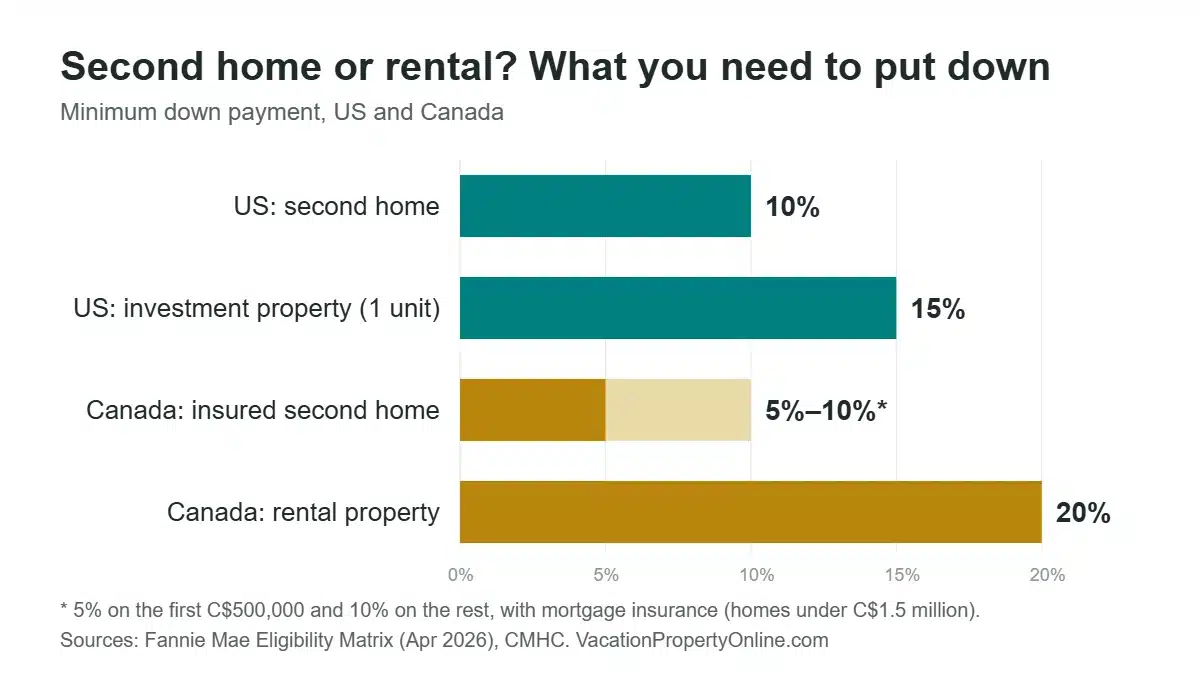
Second Home or Investment Property? Decide First
Lenders decide which loan you get by how you’ll use the property, so settle this before you apply.
Under Fannie Mae’s rules, a second home is a one-unit home you live in for part of the year, suitable for year-round use, and under your exclusive control. It can’t be in a rental property or timeshare, or be under an agreement that gives a management firm control over who stays there. You can earn some rent, but the lender won’t count it toward your income. Fannie Mae’s rules don’t require a minimum distance from your main home.
If you’ll rent the place out most of the time, or you need the rent to qualify, apply for an investment-property loan instead. It needs at least 15% down for a one-unit home, though many lenders ask for 20–25%, and costs about 0.5 points more than a main-home loan at the median in 2025.
From experience: If you’re looking for an investment property loan, shop around, because not every bank offers one. In the US, U.S. Bank lends on one- to four-unit rental and vacation properties. In Canada, CIBC’s Home Power Plan covers rental properties of up to four units that you don’t live in, with financing up to 80% of value.
US Vacation Home Loans
Second-home loan (vacation home mortgage)
This is a conventional mortgage, usually fixed for 30 years. Fannie Mae allows up to 90% financing, so the minimum down payment is 10%, and banks say the same: Chase says the minimum down payment for a conventional second-home loan “is usually 10% down.” Some lenders ask for more, depending on your credit and savings. Putting down 20% or more avoids private mortgage insurance and, as U.S. Bank notes, may get you a lower rate. With less than 20% down, you’ll pay that insurance until you have enough equity to cancel it; ask your lender how that works on a second home.
Lenders look at your total debts, including both mortgages, against your income. Fannie Mae allows a debt-to-income ratio of up to 50% on second homes approved through its automated underwriting system, but many lenders set a lower limit, often around 43–45%. Lenders also set their own credit score and savings requirements, which are often stricter than for a main home.
Investment-property loan
If you’ll rent the home out regularly, it’s an investment property. Chase notes that, for tax purposes, if you rent a second home out for more days than the IRS personal-use limits allow, “it would be considered an investment property.” Its vacation home guide also warns that renting can “sometimes violate mortgage terms.” On a second-home loan, rent doesn’t count toward qualifying: both Fannie Mae and Freddie Mac exclude it. On an investment-property loan, lenders can count part of the expected rent toward your income, but you’ll need more down and pay a higher rate.
DSCR loan
A DSCR (debt service coverage ratio) loan qualifies you mainly on whether the property’s rent covers its mortgage and costs, not on your personal income. These loans come from private lenders, not Fannie Mae, and usually cost more. They can suit short-term rental buyers and self-employed borrowers whose income is hard to document. Check each lender’s terms.
Using a HELOC or Home Equity Loan to Buy a Second Home
If you have equity in your main home, you can borrow against it for the down payment or the whole purchase. A home equity line of credit lets you draw only what you need, and you pay interest only on what you use. The rate is usually variable, so your payments can rise if rates go up. A home equity loan gives you a lump sum at a fixed rate. Either way, your main home is the security.
Cash-out refinance
You replace your main mortgage with a larger one and take the difference in cash. Fannie Mae allows a cash-out refinance of up to 80% of your main home’s value. It can make sense if your current rate is close to today’s rates, but it resets your mortgage and can raise the rate on the whole balance.
Can you use an FHA or VA loan for a vacation home?
No. FHA loans require you to live in the home, so vacation homes don’t qualify. VA loans also require the veteran to occupy the home as their own. You can use either for your main home, which may free up savings for a vacation home.
Private lenders and cash
Private lenders will lend on properties banks won’t, such as homes with seasonal access, but they typically charge more and lend for shorter terms. Paying cash avoids interest and makes your offer stronger, but it ties up savings you may need for repairs or a slow rental season.
Vacation Home Loans in Canada: Cottage and Vacation Property Mortgages
Canada’s insured mortgages cover second homes you’ll use yourself. CMHC (Canada Mortgage and Housing Corporation) is the federal Crown corporation that insures mortgages with less than 20% down, alongside private insurers Sagen and Canada Guaranty. The insurance protects the lender, and you pay the premium:
- CMHC insures second homes with year-round vehicle access, priced under C$1.5 million, for up to two properties per borrower. The minimum down payment is 5% of the first C$500,000 and 10% of the rest, with a 600 minimum credit score and total debt payments up to 44% of income.
- Canada Guaranty uses the same down payment tiers for winterized, year-round-access second homes, and excludes rentals.
- Banks add their own rules. Scotiabank finances “Type A” vacation properties up to 95% of value (insured by Sagen or CMHC above 80%) and “Type B” properties up to 90% (Sagen-insured above 75%). TD says second properties generally need at least 20% down, unless you or family will live there rent-free. Ask your bank which category your cottage falls into. In my experience, if you want the most lenders to choose from, plan on putting down at least 20%.
- The stress test: you must qualify at the higher of your rate plus 2% or 5.25%.
- Rentals need 20% down. Mortgage insurance is required with less than 20% down, and these insured programs exclude rentals, so a cottage you’ll mainly rent out needs at least 20%.
- Home equity lines at federally regulated lenders are capped at 65% of your home’s value, and 80% including your mortgage, as the Financial Consumer Agency of Canada also explains. Bank products such as TD’s Home Equity FlexLine and Scotiabank’s STEP work within that 80% total.
Illustrative Examples
United States. A $500,000 vacation home with 10% down ($50,000) means a $450,000 loan. At about 7.6%, the Freddie Mac 30-year average of 7.24% on October 29, 2026 plus the typical second-home premium, the payment is about $3,177 a month in principal and interest, plus mortgage insurance, taxes and insurance. With 20% down ($100,000), it’s about $2,824 a month and no mortgage insurance.
Canada. A C$600,000 year-round cottage you’ll use yourself needs at least C$35,000 down with mortgage insurance (5% of C$500,000 plus 10% of C$100,000). That leaves a C$565,000 loan. At 94% of the price, the CMHC premium is 4.00% (C$22,600), and it’s added to the loan, for C$587,600 in total. At about 5% interest, in line with the big banks’ 5-year fixed rates of 4.84% to 5.19% on November 1, 2026, over 25 years, the payment is about C$3,418 a month in principal and interest, plus property tax and insurance. With 20% down (C$120,000), which you’ll need anyway if you plan to rent it out, the loan is C$480,000 with no insurance premium. At about 5% interest, the payment is about C$2,792 a month. Rates on rental properties may be higher, so ask your lender.
Run your own numbers →
- Can I Afford a Vacation Home Calculator: see what price fits your budget
- Vacation Home Mortgage Calculator: estimate your monthly payment
- Investment Property Affordability Calculator: if you’ll rent it out
- Airbnb ROI Calculator: test whether short-term rental income covers the costs
Frequently Asked Questions
Is it hard to get a mortgage for a vacation home?
It’s harder than for a main home, but not unusual. Lenders want solid credit, room for both mortgage payments within their debt-to-income limit (Fannie Mae allows up to 50%, but many lenders set a lower limit, often around 43–45%), and at least 10% down in the US.
What are the requirements for a vacation home loan?
In the US, a second-home mortgage needs at least 10% down, a debt-to-income ratio of up to 50% including both mortgages (many lenders set a lower limit, often around 43–45%), and solid credit and savings. In Canada, an insured second home you’ll use yourself needs 5% of the first C$500,000 and 10% of the rest, or 20% without insurance, and you must pass the mortgage stress test.
Do you have to put 20% down on a vacation home?
No. In the US, 10% is the minimum for a second-home mortgage, though under 20% you’ll pay mortgage insurance. In Canada, an insured second home you use yourself can start at 5%. Rentals need more: 15% for a US investment loan (many lenders ask 20–25%) and 20% in Canada.
What is the current interest rate for a vacation home?
The US 30-year average was 7.24% on October 29, 2026, and second-home loans typically cost about 0.375 points more, so roughly 7.6%. Your rate depends on your credit, down payment and lender.
What is the best way to finance a vacation home?
If you’ll mainly use it yourself, a second-home mortgage usually costs the least. If you have plenty of equity and want to move fast, a home equity line can fund the down payment or a cash offer. If you’ll mostly rent it out, apply for an investment-property loan.
Can rental income help me qualify?
Not on a second-home mortgage. On an investment-property or DSCR loan, the lender can count part of the expected rent.
Can I use a VA loan for a vacation home?
No. VA loans require you to live in the home.
This article is general information, not financial advice. Talk to a lender or mortgage broker about your situation.
